
Quantum Observer #3 - Quantum Progress Hits Overdrive
Helios launched, neutral atoms surprised, IBM flexed… and somewhere, a wellness influencer discovered “quantum resonance”

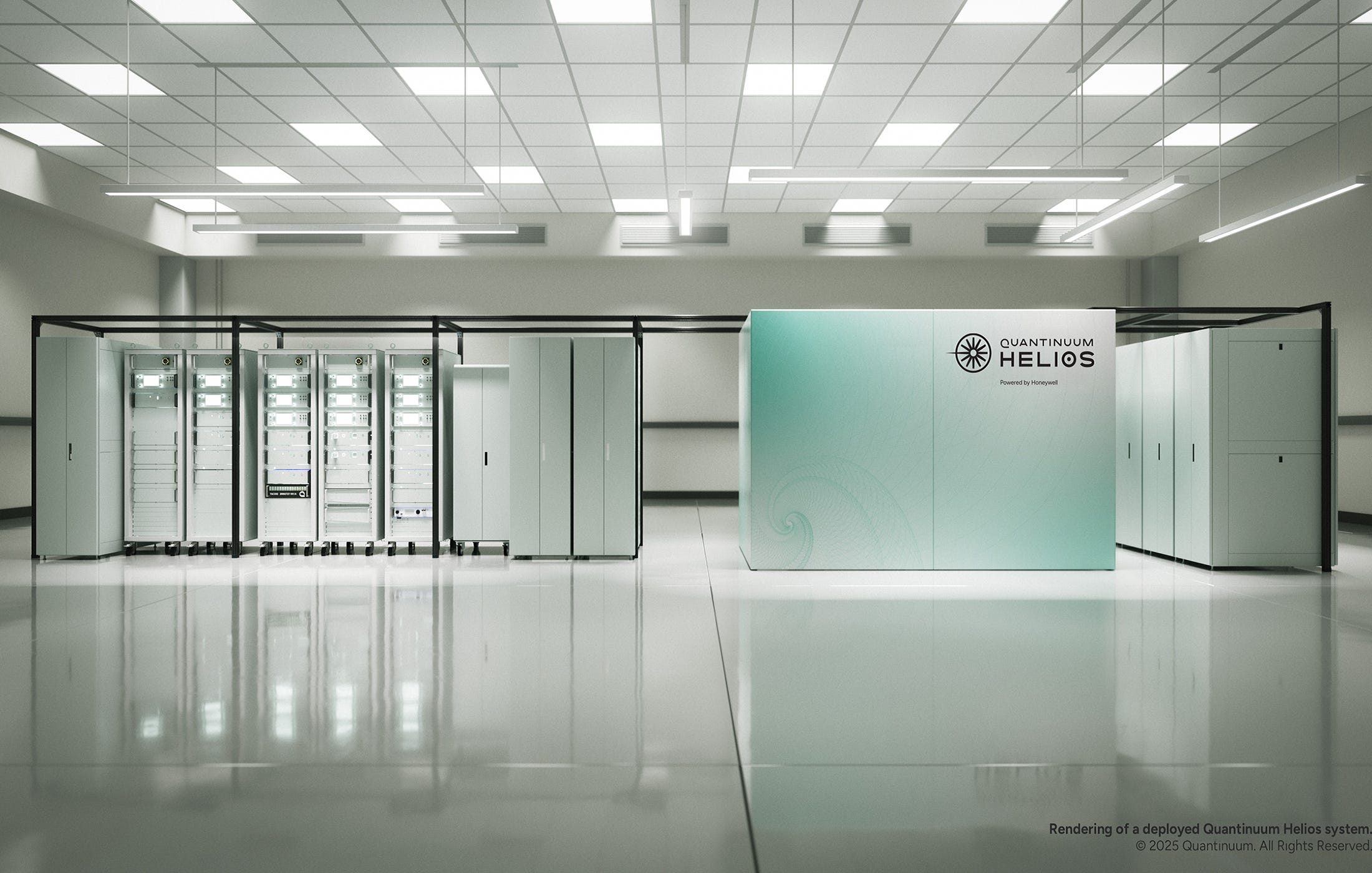
In this edition: Another busy period in quantum: Quantinuum launched Helios, claimed a new form of quantum advantage, and added more evidence that error-corrected quantum computing is finally moving from theory to practice. Google, IonQ, and IBM all dropped major updates in the same two-week window, and IBM continues hitting its roadmap milestones ahead of schedule. Meanwhile, neutral-atom platforms - especially Harvard/QuEra - delivered stunning below-threshold results, joining superconducting and trapped-ion qubits as serious contenders for fault-tolerant quantum computing. Beyond the lab, governments and investors poured billions into quantum programs worldwide, from DARPA to California, the UK, the EU, and an $800M mega-round for Quantinuum. We also saw notable progress in QKD, coherence times, and city-scale quantum networking. And yes… this week’s Quantum Flapdoodle features a new wave of “quantum” pendants and stickers claiming to heal, block radiation, and manifest abundance. Spoiler: they don’t. Enjoy the tour.
In this edition, we highlight key recent news in quantum computing – and, this time, try to connect them to prior breakthroughs over the last few months to keep the big picture in focus.
The firehose of amazing achievements is flowing faster than ever, making it hard to track what’s going on! Let’s break it down.
Helios and the Quantum Advantage Relay
Quantinuum’s Helios Launch: The big news of the week was Quantinuum’s release of Helios, a new 98-qubit trapped-ion quantum computer. Billed as “the world’s most accurate” commercial quantum system, Helios achieves record two-qubit gate fidelity (~99.921%) and introduces an innovative architecture using barium ion qubits. It’s designed for hybrid quantum-classical processing with a real-time control engine and even a new programming language (Guppy) for seamlessly mixing classical and quantum code. Helios also marks Quantinuum’s first deployment outside the US (planned for Singapore), underscoring the company’s global ambitions. My in-depth analysis of the Helios architecture (including its use of QCCD ion transport for all-to-all connectivity and memory/logic separation) is available for those wanting a deep dive. In short, Helios nearly doubles Quantinuum’s qubit count (98 vs. 56 in H2) while improving fidelity – a major leap in scaling without noise penalty.
Demonstrating Quantum Advantage: Beyond the shiny hardware, the real story is that Helios has now demonstrated quantum advantage – twice over. (Please note that there are as many definitions of quantum advantage, and opinions about whether it was achieved in these examples, as there are quantum technology observers.) As I unpack in this article on Quantinuum’s Helios quantum advantage, the system first pushes deep random-circuit sampling to a regime where even exascale supercomputers would need absurd resources (think “longer than the age of the universe” and “more power than all visible stars”) to keep up. Then it goes further and tackles a Fermi–Hubbard simulation of high-temperature superconductivity on a 6×6 lattice – a task that is effectively out of reach for classical methods. This latest claim lands just two weeks after Google’s new verifiable quantum advantage result and shortly after IonQ’s record-setting trapped-ion experiment, and only days before IBM unveiled its Nighthawk and Loon chips as key waypoints on their advantage-to-fault-tolerance roadmap. Quantum advantage is starting to look less like a one-off headline and more like a relay race.
Fully Error-Corrected Gates Arrive: Stepping back to June, Quantinuum also made waves by declaring it’s the first to demonstrate a fully error-corrected universal gate set. What does that mean? Essentially, they performed all types of quantum logic operations (Clifford and non-Clifford gates) on logical qubits with errors detected and corrected in real-time. This was achieved by generating high-fidelity “magic” states and using them to implement a non-Clifford T-gate fault-tolerantly. It closed a long-standing gap – previously, error-corrected qubits could handle the easier Clifford gates, but the hardest gate (T) was too error-prone. Quantinuum’s result showed a path to incorporate every gate needed for universal computing under error correction. In other words, they claim all the ingredients for at-scale fault-tolerance are now on the table, giving them a “de-risked” roadmap to a full fault-tolerant machine by 2029. This achievement set the stage for the flurry of quantum advantage claims that followed in this latest period – it’s as if once error correction started working, useful quantum computations quickly began popping up.
IBM’s Roadmap Discipline: Speaking of fault-tolerance, IBM has been hitting its own milestones. In October, IBM announced it ran quantum error-correction algorithms on off-the-shelf AMD hardware – and did so 10× faster than required. This was a test of their classical control system for error correction, and running it on standard FPGAs a year ahead of schedule shows IBM’s engineering discipline. In fact, it’s the third roadmap milestone IBM delivered significantly early (others include previous processor releases and software stack updates). IBM’s latest Nov 12 update introduced the 120-qubit Nighthawk chip aimed at quantum advantage by 2026, and the Loon test chip to lay groundwork for fault tolerance by 2029. With each milestone met or exceeded, my confidence (and frankly, concern!) grows that IBM will hit a commercially viable fault-tolerant quantum computer within the next few years. The pace and engineering discipline are remarkable – they’re making a very complex effort look almost routine.
Bottom line for this section: We’ve seen a cascade of achievements – error-corrected gates, back-to-back quantum advantage experiments, new high-qubit chips – all within a matter of months. The acceleration of quantum tech progress is accelerating 🙂, and it’s genuinely hard to keep up. Now let’s turn to a dark horse in the race that’s suddenly looking like a front-runner: neutral atoms.
Neutral Atoms Level Up
If superconducting qubits and trapped ions have dominated the spotlight, neutral-atom quantum computers just dramatically elbowed their way into contention. I’m particularly bullish about a massive result from Harvard/QuEra (Mikhail Lukin’s team) that achieved a fault-tolerance milestone with neutral atoms. This is the same group that in late 2023 demonstrated a logical qubit on a neutral-atom processor with performance improving as code distance increased – one of the most consequential results of that year. Just two months ago, in September, they also kept a 3,000+ qubit neutral atom array running continuously for over 2 hours, swapping out atoms to overcome loss and essentially achieving an “infinite” runtime quantum simulator. These achievements were already remarkable, but the latest news goes even further.
Below-Threshold Error Correction: The new Harvard-led experiment (reported in Nature) used a 448-atom array to implement a small surface code and showed it operating below the error threshold – meaning adding more qubits in the code actually suppressed errors instead of amplifying them. In practice, they did repeated rounds of error correction and observed that a distance-5 code had lower logical error rates than a distance-3 code, a clear signature of true error-correcting behavior. This is huge: it’s proof that neutral atom qubits can be scaled into the error-correcting regime needed for fault-tolerant quantum computing. Combined with their 2023 logical qubit work, it signals that neutral-atom platforms are no longer just “science experiments” but serious competitors on the fault-tolerance path. The Harvard/QuEra team essentially achieved with 448 optical tweezed atoms what Google did with 72 superconducting qubits – a below-threshold logical qubit – but with a very different technology. This result caught many off guard and is forcing a recalculation of modality race rankings.
Recent Neutral-Atom Milestones: Let’s not forget other neutral-atom feats in recent weeks. Caltech set a record with a 6,100-qubit optical tweezer array. They held thousands of cesium atoms in superposition for 13 seconds and achieved 99.98% single-qubit control fidelity. That demonstrated not just scale, but quality at scale, which is vital for error correction. And in China, a startup unveiled Hǎnyuán-1, a 100-qubit neutral-atom quantum computer that’s fully operational at room temperature (qubits inside are still laser-cooled). It’s already been delivered to customers (including China Mobile) and marks one of the first commercial sales of a Chinese quantum computer. Notably, Hǎnyuán-1 fits in standard server racks and uses locally sourced lasers and optics – an impressive engineering feat emphasizing compact design and domestic supply chains.
All this positions neutral atoms as a serious contender alongside superconducting and trapped-ion qubits. With the Harvard result showing below-threshold error rates, neutral-atom systems might achieve multiple logical qubits sooner than many expected. They also offer unique advantages: huge qubit counts (thousands of atoms), 3D connectivity (via moving atoms or connecting arrays with light), and operation at higher temperatures (even room temp for some designs).
The field is now extremely exciting – we effectively have three horse breeds in the race to scale: the long-favored superconducting circuits, the steady and high-fidelity trapped ions, and now these dark-horse neutral atoms proving their mettle. Competition usually breeds progress, so having three viable modalities can only accelerate the roadmap to large-scale quantum computers.
Why “Below Threshold” Matters So Much
When you hear “below threshold” for quantum error correction, that’s really important. It refers to achieving physical qubit error rates low enough that adding more qubits in an error-correcting code actually reduces the logical error. This was a theoretical must-have for decades, and it’s finally being demonstrated in practice – first by Google earlier in 2023, and now by Harvard on a different platform. In my framework for predicting CRQC (cryptographically relevant quantum computers), reaching below-threshold QEC is a critical capability, because it’s the turning point where we can start scaling up logical qubits without the error burden blowing up.
Google’s Milestone: Back in early 2023, Google Quantum AI showed the first “bigger code beats smaller code” result on a superconducting chip – the experiment covered in my piece Google Claims Breakthrough in Quantum Error Correction. They compared a distance-5 surface code (49 qubits) to a distance-3 code (17 qubits) and found that the larger code had a slightly lower logical error rate (~2.9% vs 3.0% per cycle). On paper that’s only a ~0.1% improvement, but it was historic: it was the first clear sign that their hardware had effectively crossed the surface-code threshold, so adding more qubits to the code actually reduced logical errors instead of amplifying them. That experiment was the original “key signature of QEC” moment. Fast-forward to the end of 2024, and Google pushed this much further with the Willow processors, described in Google AI’s Surface Code Breaks the Quantum Error Threshold. This time they ran distance-5 and distance-7 surface codes on 72- and 105-qubit Willow chips and saw the logical error drop from ~0.3% to ~0.143% per cycle as they increased the code size. Crucially, the distance-7 logical memory outlived the best physical qubit on the chip and operated as a sustained below-threshold quantum memory with real-time decoding over up to a million QEC cycles. So you can think of 2023 as the first “crossover” demonstration and the Willow result as the full-blown, below-threshold quantum memory milestone.
Harvard’s Leap: Fast-forward to now – the Harvard neutral atom experiment achieved a similar below-threshold feat in a very different system. Two independent demonstrations (and rumors of others in the works) give confidence that below-threshold QEC is not a one-off. It appears multiple platforms are entering an era where logical qubits can retain information longer than the best physical qubits, by using redundancy and smart encoding. This is the transition point from the NISQ era to the dawn of fault tolerance.
These latest below-threshold results motivated me to compila a dedicated piece collecting and examining the recent QEC experiments across platforms. If you’re into the nuts and bolts of error correction, check out my article on the spate of “QEC below threshold” experiments and what they imply for timelines. The upshot is that quantum computing now has a clear foothold on the mountain of scalability. We’re not at the summit, but we can finally see a route up.
And That’s Not All… More Tech Breakthroughs
You’d think the above was plenty for a week – but there’s even more happening in quantum tech development:
Longer-Lived Qubits: A team at Princeton built a superconducting qubit with a coherence time over 1 millisecond – 3× longer than the previous record. This is the largest single leap in qubit lifetime in over a decade. A millisecond may not sound like much, but for quantum it’s huge – longer coherence directly means fewer errors. One of the researchers noted that if you simply swapped these tantalum qubits into Google or IBM’s processors, error rates could drop 1000×. That could cut the overhead for error correction dramatically. Even better, the new qubit design is compatible with existing transmon tech, so industry could adopt it relatively quickly.
Quantum Networks & QKD: On the communications front, researchers demonstrated quantum key distribution (QKD) over 120 km of standard optical fiber, while that fiber carried regular internet traffic. This broke distance records for continuous-variable QKD in a real-world scenario. They managed to send quantum encrypted keys and classical data simultaneously by clever filtering and use of a “built-in” wavelength that minimized interference. Why does that matter? It shows quantum-secure links can be integrated into existing telecom infrastructure over metropolitan-scale distances (120 km could cover a large city and suburbs). It’s a step toward a practical quantum internet. On a related note, IonQ and a Swiss consortium launched a city-scale quantum network in Geneva connecting CERN, the University of Geneva, and even a luxury watch company via optical fiber. The network (Geneva Quantum Network) uses ID Quantique’s QKD devices (IonQ acquired a stake in IDQ) to enable secure quantum key exchange across town, and it’s testing entanglement distribution between nodes. They even synchronize the network with atomic clocks from Rolex for ultra-precise timing. It’s one of the first city-wide quantum networks that isn’t just a lab demo – it involves real institutions and is a template for future secure communications infrastructure.
These developments show that quantum coherence, communication, and computing are all advancing in parallel. We’re extending how long qubits can last, how far quantum signals can travel, and how well quantum algorithms can outperform classical ones. Hard problems remain, but the pieces of the puzzle are falling into place, one breakthrough at a time.
Business & Policy News Roundup
It’s not just technical milestones – the past week also saw significant business, funding, and policy news in quantum:
DARPA QBI Stage B: The U.S. DARPA advanced 11 companies to Stage B of its Quantum Benchmarking Initiative. This means firms like IBM, Quantinuum, Atom Computing, and others showed plausible plans for a utility-scale quantum computer in Stage A, and now get funding to develop detailed R&D roadmaps. The fact that 11 companies made the cut shows how many serious efforts are underway. DARPA will rigorously evaluate their plans – and those that impress could receive even bigger support (and bragging rights).
“Quantum California” Initiative: California launched a state-backed quantum technology program, aptly named Quantum California. Governor Newsom announced an initial $4 million (in the 2025–26 budget) to kickstart it, along with new legislation (Assembly Bill 940) to coordinate academia, industry, and government efforts.
UK’s Quantum Showcase: Over in the UK, the government used its National Quantum Technologies Showcase event in London to unveil a slate of new investments. They branded the coming years the “Quantum Decade” and backed it up with fresh funding and collaborations.
Quantinuum’s $800M Mega-Round: On the corporate side, Quantinuum raised an eye-popping $800 million in a funding round valuing the company at ~$10 billion. This is one of the largest investments ever in a quantum startup. Notably, the same week, Canada’s photonics QC startup Xanadu announced plans to go public via SPAC at a ~$3.6B valuation. Big financings and exits like these signal that quantum tech is maturing from lab research to a commercial industry – and that capital markets see enough progress to justify multi-billion-dollar bets.
US National Quantum Centers Renewed: The U.S. Department of Energy committed $625 million to renew its five National Quantum Information Science Centers for another five years. These centers (originally launched in 2020 with roughly $115M each) are major multi-institution hubs pushing research in areas from quantum computing to materials to networking. The renewal ensures these centers will continue their work into the late 2020s. It’s basically a vote of confidence that the initial five years went well, and now the feds are doubling down with another half-billion+ to keep the momentum.
EU’s Quantum Act Plans: Not to be outdone, the EU announced plans for a comprehensive “Quantum Act” at the European level. The European Commission opened a public consultation to shape this legislation, which is slated for 2026. The Act’s goals mirror other big initiatives (think EU Chips Act but for quantum): boost R&D funding across member states, scale up industrial capacity (like establishing pilot production lines and a quantum chip design facility in Europe), and ensure supply chain resilience and governance (since quantum is dual-use tech). It’s a space to watch, especially for companies operating in Europe – support and requirements may ramp up significantly.
As you can see, governments and investors worldwide are investing big in quantum right now. We’re in that phase where policy is catching up to technology, and money is starting to flow at scale. It’s a strong indicator that people in power believe quantum tech will be strategically important in the near future – not some 20-year-away sci-fi. For those of us tracking “Q-Day” (the day quantum breaks crypto), these developments on both tech and funding fronts suggest the timeline is steadily firming up.
Personal Note – Podcast Appearance
On a personal note, I had the pleasure of chatting on the SANS “Cyber Leaders” podcast this week alongside my colleague Kawin. We discussed “Quantum’s Leap – how cyber leaders are preparing for the post-encryption era.” It was a great conversation about the practical steps organizations should take now to get ready for quantum risks (like doing crypto inventories, prioritizing data migration to PQC, etc.), as well as the opportunities quantum tech offers. If you’re interested in cybersecurity strategy in this quantum-transition period, you might enjoy that episode. It’s now out on the SANS Cyber Leaders podcast feed (Episode 21). I won’t self-promote too hard here, but I figured I’d mention it since many of you are on the cyber side of the house and these topics tie directly into what we discuss in this newsletter.
Quantum Flapdoodle of the Week
Not all quantum quackery comes in the form of multi-million dollar scams – some of it is peddled as cheap trinkets and wellness gadgets targeted at the general public. Lately, there’s been an uptick of products like “quantum energy” stickers for phones (claiming to block 5G or EMF radiation) and pendants or bracelets “infused with quantum resonance” to relieve pain or “harmonize your body’s frequency.” These products love to sprinkle real scientific terms like frequency, energy, quantum – but in a completely nonsensical context. For example, one vendor advertises “quantum jewelry” that will “optimize your health, protect from EMFs, manifest success, and evolve your energy” via bioresonance technology. Phrases like “powered by quantum technology” abound, but there’s no actual quantum mechanism at work – it’s technobabble dressed up to sound high-tech.
Let’s be very clear: no sticker, pendant, or bracelet can harness quantum physics to heal you or block cell signals. Zero. Zilch. There is no reputable scientific evidence that sticking a so-called quantum patch on your phone does anything except perhaps make your wallet lighter. Physicists and medical experts are unequivocal: these are at best placebo devices. And there’s a darker side – if people rely on them for protection (say, thinking a necklace will cure their ailments or shield them from radiation), they might neglect real medical treatments or safety measures, which is dangerous. In some cases, the “quantum” gimmick products have proven to be literally dangerous: certain negative-ion “quantum pendants” were found to contain radioactive material and emit low levels of ionizing radiation. (Yes, ironically the anti-5G pendants were mildly radioactive – you can’t make this stuff up!) Regulators have since banned those, but it shows how snake oil can sometimes bite back.
The bottom line is, slapping the word “quantum” on age-old snake oil doesn’t make it science – it makes it suspect. As quantum tech becomes more famous, marketers will keep abusing the buzzword. So, if you see a miracle gadget promising health, protection, or cosmic enlightenment based on “quantum” mumbo-jumbo, bring a healthy dose of skepticism. Save your money for real innovations (like a nice quantum computing textbook 😁) and enjoy the fact that knowledge is the best defense against this kind of flapdoodle.
New on PostQuantum.com – Company DB Updates & Due Diligence Guide
In website news, I’ve updated my database of quantum computing hardware companies and their roadmaps (2025 edition). This is a resource where you can filter and compare major players by modality, track record, etc., with summaries of their milestones and plans. This week I added several new companies to the list, including Silicon Quantum Computing (Australia), Quantum Motion (UK), and Photonic Inc. (Canada). These are startups pursuing silicon-based qubits (Silicon QC and Quantum Motion) and distributed photonic+spin architectures (Photonic Inc.), respectively. All three have interesting approaches (e.g. Silicon Quantum Computing is literally making atomic-scale silicon qubits using scanning tunneling microscopes; Quantum Motion is leveraging CMOS fabrication for spins; Photonic Inc. is networking small silicon spin processors with photonic links). With these additions, the database covers an even wider spectrum of the quantum landscape – now 30+ companies from superconducting to topological to neutral atoms. Feel free to explore it; I hope it’s useful for getting a snapshot of who’s doing what, and how close they are to the coveted fault-tolerant CRQC threshold.
I also wrote a timely piece on quantum computing due diligence – essentially a field guide for evaluating quantum startups, technologies, and claims. With so many companies touting breakthroughs (and now big funding rounds and SPACs in the mix), it’s important to be able to discern hype versus reality. In the article, I share my personal toolkit of questions and red flags when I assess a quantum company: from examining their error rates and roadmaps, to checking for independent validations, to judging whether they’re over-claiming about “revolutionary” physics. The goal is to avoid both extreme ends – neither dismiss real progress nor fall for hand-wavy mystique. I thought this was timely given the influx of new entrants and the marketing that inevitably accompanies investment. If you’re an investor, customer, or just an enthusiast who wants to sharpen your BS-detector in the quantum space, give it a read. It might save you from wasting money or time on something that sounds too good to be true (or conversely, help you spot a gem that others underrated).
That’s it for this week’s whirlwind tour! We covered a lot, from cutting-edge hardware launches and error-correction feats to policy moves and yes, even quantum-adjacent craziness. The quantum world is moving fast on all fronts.
Even if you don’t click the many links, I hope this gave you a sense of the momentum – and maybe a couple of chuckles (or eye-rolls) regarding the quackery.
As always, feel free to reach out with questions or topics you’d like to hear more about.
Until next time, stay curious and watch out for those “quantum” snake oil salesmen!